
Roughly 9-10 crore Indians hold a demat account. Out of a population of 140-plus crore, that’s barely 1 in 15 people owning even a single share. In the US, more than half of adults own stock in some form. India is routinely called the world’s fastest-growing major economy - GDP beats expectations, IPOs list at record valuations — and yet most of the country watches that growth from the sidelines.
That gap is the real substance behind “economic inclusion”: genuine inclusion was never just about having a job or a bank account. It’s about holding a piece of the value an economy creates.
The Saver v/s the Owner
A saver lends money to the system and receives a fixed, modest, capped return. An owner buys a stake in the system itself, and their return is whatever it actually produces. Saving alone cannot close India’s wealth gap, because it’s the only vehicle where money grows with the economy rather than sitting beside it.
This is where a lot of financially disciplined Indians go wrong - not through recklessness, but by treating a fixed deposit as their “investment portfolio.” After inflation, many traditional instruments barely preserve purchasing power. If an FD earns 6%-7% and inflation runs at 5%, the real return is a rounding error.
The Ownership Vehicles Already Available
India doesn’t need a new financial product — the on-ramps already exist and cost far less than people assume.
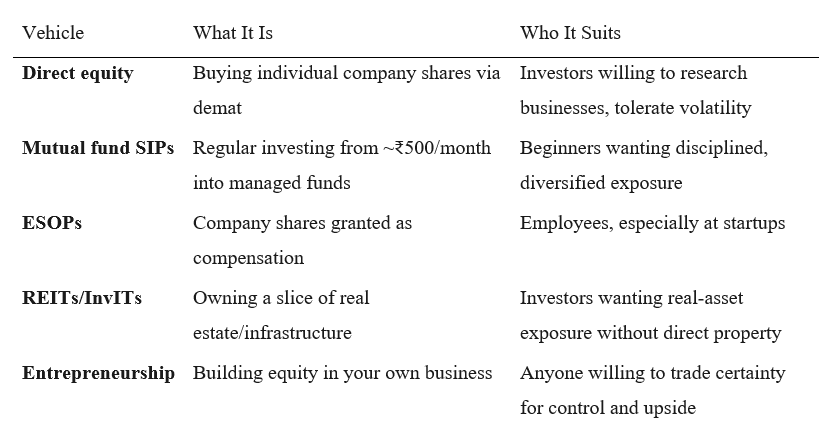
Why the Gap Persists
Three barriers explain most of it: low financial literacy, especially outside metro cities - many first-generation earners were never taught how compounding or risk pricing actually works; a lingering trust deficit from past scams and crashes, even though SEBI-regulated markets today are far more transparent; and access friction in rural and semi-urban India, where advisors and platforms remain thin on the ground. Of the three, literacy arguably drives the other two - understanding how markets work makes it easier to spot a regulated fund versus a fraudulent scheme.
Building an Ownership Culture
Closing this gap needs financial education starting in schools, simplified mobile-first investment platforms, wider ESOP adoption as India’s startup ecosystem matures, entrepreneurship support outside the big metros, and continued SEBI/RBI regulatory work. None of these work in isolation - a simplified app doesn’t help someone who doesn’t trust markets. Real financial literacy, the kind that goes beyond exam syllabi into genuine applied understanding, is the connective tissue that makes every other lever functional.
Growth that isn’t shared eventually runs out of runway. The question isn’t whether India’s economy will keep growing - it will. It’s whether more Indians will own a piece of it as it happens.
Frequently Asked Questions
What does “economic inclusion” mean in the Indian context?
It means holding a genuine stake in the value the economy creates — through equity or entrepreneurship — so growth translates into personal wealth, not just GDP headlines.
Is stock market investing only for wealthy or urban Indians?
No. SIPs can start around ₹500/month, and demat accounts are now largely digital and near-free. The real barrier is awareness, not minimum capital.
What’s the safest way for a beginner to start?
Most educators recommend diversified mutual fund SIPs before direct equity — professional management and rupee-cost averaging smooth out volatility while confidence builds.
Why do so many Indians still prefer gold and real estate over equity?
Cultural trust in tangible assets, memories of past scams, and limited financial literacy — even though physical assets are often less liquid and deliver lower inflation-adjusted returns over time.
Behind every article is the SSEI Team, bringing together educators, finance professionals, and content specialists to make finance easier to understand.
View All Articles