
Related Posts



In 2008, putting ₹6.4 crore into an Indian online bookstore looked more like a gamble than an investment. Online shopping was still new, digital payments were far from mainstream, and Flipkart was just getting started. Accel invested anyway.
Ten years later, Walmart agreed to spend ₹1.33 lakh crore for a 77% stake in Flipkart, valuing the company at roughly ₹1.75 lakh crore. Sounds like the perfect VC story: invest early, wait, and make a fortune.
But whose fortune was it really? The founders'? Accel's? Or the investors who had supplied money to Accel's fund?
Because the money a VC puts into a startup is often not entirely its own. So to understand who really made money from a bet like Flipkart, we first need to follow the money backwards: where did it come from, who controlled it, and who ultimately got the returns?
So, what is venture capital?
The word “VC” gets used loosely for the investor, the firm, the fund and even the financing itself. That is where a lot of the confusion starts.
Venture capital is a form of financing in which investors provide capital to privately held companies in exchange for an ownership stake. Unlike a bank loan, the money is generally not repaid through fixed installments with interest. The investor's outcome depends on what eventually happens to the value of that equity.
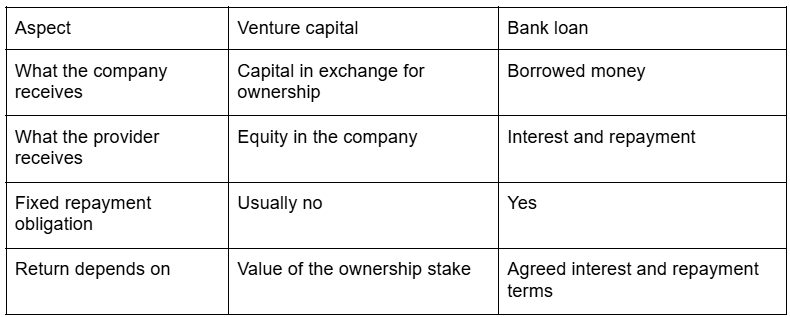
This can suit young companies that need money to expand but may not yet have the cash flows, collateral or operating history typically required for conventional borrowing.
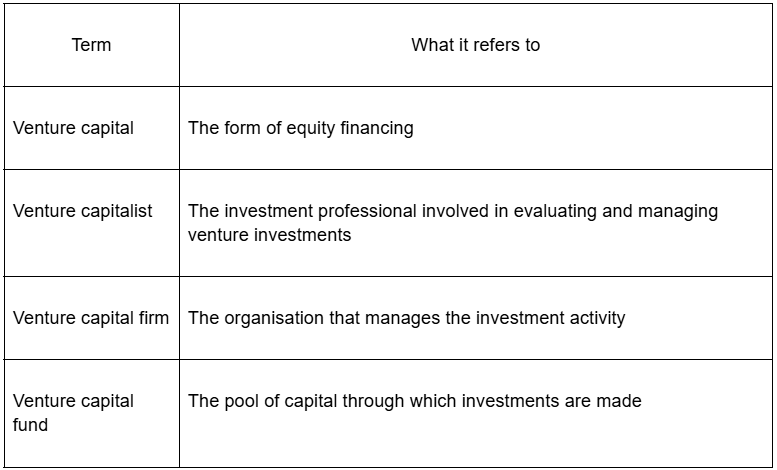
A venture capitalist, therefore, is not necessarily investing only personal wealth. In a typical fund structure, the VC helps decide where pooled investor capital should be deployed and manages those investments after they are made.
That resolves one part of the opening puzzle. The next is more important:
Where Does a Venture Capital Fund Get Its Money?
A venture capital fund may invest in startups, but the people running the fund usually did not supply all of that money themselves.
Most of the capital typically comes from outside investors known as limited partners, or LPs. Depending on the fund, these can include family offices, pension funds, endowments, insurance companies, institutions, and high-net-worth individuals.
The fund is managed by the general partner, or GP, which is responsible for deciding where that capital should be invested.
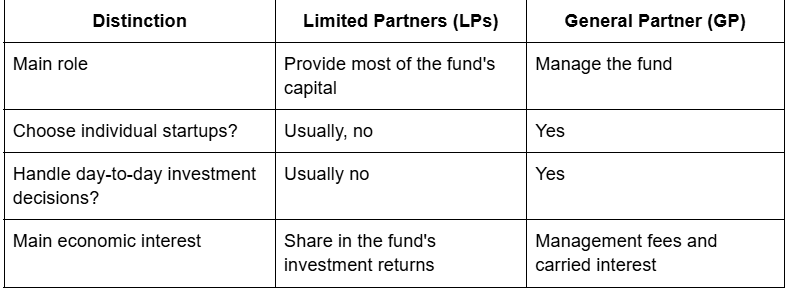
Take SoftBank’s Vision Fund. When the fund invested billions of dollars in companies such as Flipkart, Uber and WeWork, it was easy to describe those deals as “SoftBank investments.”
But SoftBank was not the only source of that money.
The Vision Fund itself was backed by large investors, including Saudi Arabia’s Public Investment Fund and Abu Dhabi’s Mubadala, alongside SoftBank. In other words, SoftBank helped decide which companies the fund would back, while a significant part of the capital came from investors in the fund.
That is the distinction between the fund manager and its LPs. And even when an LP commits, say, ₹20 crore to a fund, the entire amount does not necessarily arrive on day one. The fund can draw that money in stages as investment opportunities arise, through what is known as a capital call.
So, how do venture capital firms make money?
A startup becoming more valuable does not automatically put money into a VC firm’s bank account. VC firms generally earn in two ways: management fees, which are paid for running the fund, and carried interest, which gives the fund manager a share of eligible profits when investments are successfully realised.
That word, realised, matters.
If a fund invests ₹10 crore in a startup and its stake later becomes worth ₹50 crore, the ₹40 crore increase is still a paper gain until the shares are actually sold through an acquisition, IPO, secondary sale or another exit. Take Sequoia Capital’s investment in WhatsApp
Sequoia backed WhatsApp years before it became one of the world’s biggest messaging apps, investing while the company was still privately held. As WhatsApp grew, Sequoia’s stake became far more valuable on paper. But a higher private-market valuation alone did not mean that value had been turned into cash.
The major liquidity event came in 2014, when Facebook agreed to acquire WhatsApp in a deal initially valued at about $19 billion. That acquisition gave WhatsApp’s shareholders, including Sequoia, a way to convert the value of their shares into actual proceeds.
And this is where the fund’s distribution rules start to matter.
The proceeds attributable to the investment flow back through the fund and are distributed according to the fund agreement. The LPs receive their share, while the fund manager may earn carried interest on qualifying profits.
For example, if a fund ultimately generated ₹80 crore of eligible profit and its agreement provided for 20% carry, the simplified calculation would be:
₹80 crore × 20% = ₹16 crore
Actual distributions can be more complicated because invested capital may need to be returned first, and hurdle rates, waterfalls or other conditions may apply.
So a startup’s valuation tells us what an investment may be worth. An exit like WhatsApp’s acquisition is what can turn that value into realised returns. Only after that do the fund’s distribution rules determine how much goes back to investors and how much the VC manager may earn as carry.
How Is Venture Capital Different From Angel Investing and Private Equity?
By this point, one thing should be clear: venture capital is not simply someone putting personal money into a promising business. It usually operates through a fund, with outside investors supplying capital and a GP managing it.
That is also what separates it from some other forms of private investing.
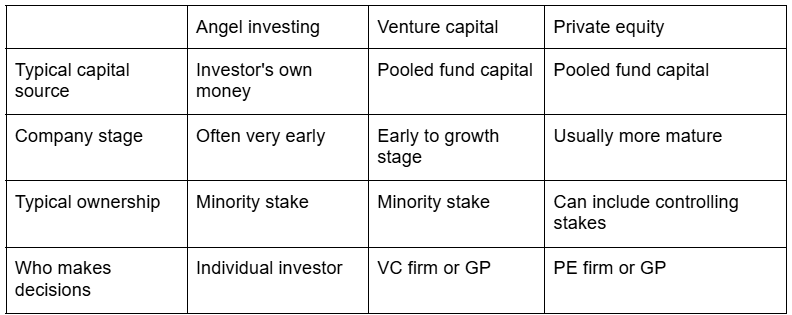
The easiest way to see the difference is to follow the money.
When Ratan Tata invested in Ola, he was investing in his personal capacity. That is closer to the traditional angel-investor model: his money, his investment decision, his stake.
When Accel invested in Flipkart, the structure was different. Accel was investing through venture funds backed by investors, or LPs. The VC selected the company and managed the investment, but the capital inside the fund was not simply the personal money of Accel’s partners.
Then consider Blackstone’s investment in Mphasis. Private equity also commonly invests through pooled funds, but it typically targets more mature businesses and can buy much larger stakes. Blackstone, for example, acquired a majority stake in Mphasis, giving it a level of ownership and influence that is less common in a typical early-stage VC deal.
So while all three can involve investing in companies outside the traditional public-market route, the key questions are different: Whose money is being invested? How mature is the company? And how much ownership does the investor want?
Conclusion
Venture capital is easy to misunderstand when the investment, the fund, and the VC firm are treated as the same thing. A higher startup valuation does not automatically become cash, and cash received by the fund does not automatically become income for the manager.
The clearer way to think about VC is this: capital is pooled, invested, realised and then distributed. Only after that do management fees and carried interest explain how the VC firm itself earns money.
Behind every article is the SSEI Team, bringing together educators, finance professionals, and content specialists to make finance easier to understand.
View All Articles