
Related Posts
You are at the dealership, ready to finance a new car. The lender runs a credit check and the number on the screen is lower than you expected.That is surprising because you have not missed an EMI or credit card payment.
So, why is your CIBIL score still low? Because the score may be picking up things you are not even looking at.
What Does a CIBIL Score Actually Measure?
A CIBIL score is a three-digit number between 300 and 900 that reflects how you have managed credit over time. Paying on time is one important part of that assessment, but it is not the only one. Your salary, savings, or bank balance do not directly determine the score.
TransUnion CIBIL calculates the score using information in your Credit Information Report (CIR). The CIR is the detailed record behind the score and includes information such as your credit accounts, outstanding balances, repayment history and recent credit enquiries.
In simple terms:

Lenders can use this score, along with other information, while assessing a loan or credit application. And if you do not have a CIBIL score at all, that does not automatically mean bad credit. It may simply mean there is not enough qualifying credit history available to generate one.
The next question, then, is :
What Can Affect Your CIBIL Score?
TransUnion CIBIL does not disclose the exact formula used to calculate a score or the weight assigned to each factor. However, its guidance points to five broad areas of your credit history that can influence it:
- Repayment history: Whether you have paid EMIs and credit card dues on time.
- Credit utilisation: How much of your available revolving credit you are using.
- Length of credit history: How long you have been managing credit accounts.
- Credit mix: The combination of secured and unsecured credit in your profile.
- Recent credit enquiries: How frequently you have applied for new loans or credit cards.
Repayment issues are usually easier to identify. A delayed payment may appear in your report as DPD, or Days Past Due, which shows how many days a payment remained overdue. Paying the amount later may clear the dues, but it does not necessarily remove the previously reported delay from your credit history.
If your repayment record is already clean, the more useful place to look is at the other factors. And one of the most commonly overlooked is credit utilisation.
How Does Credit Utilisation Affect Your CIBIL Score?
Suppose your credit card has a limit of ₹1,00,000 and you regularly spend ₹75,000 on it. You still pay the bill in full and on time every month. From your side, repayment is perfect. But your credit report is also showing that you are using 75% of the credit available to you.
That is credit utilisation.

So: ₹75,000 ÷ ₹1,00,000 × 100 = 75% utilisation
This is why two borrowers with equally clean repayment records can still have different credit profiles. TransUnion CIBIL recognises credit utilisation as a factor that can affect the score, but it does not publish 30% as an official cut-off. A better rule is to avoid consistently using a very large share of your available revolving credit where possible.
The next factor is harder to change because it depends largely on time: the length of your credit history.
Why Does the Length of Your Credit History Matter?
Rohan got his first credit card six months ago. He pays every bill on time, keeps his usage under control, and has never missed a due date.His colleague, meanwhile, has been using credit for eight years with the same clean repayment record.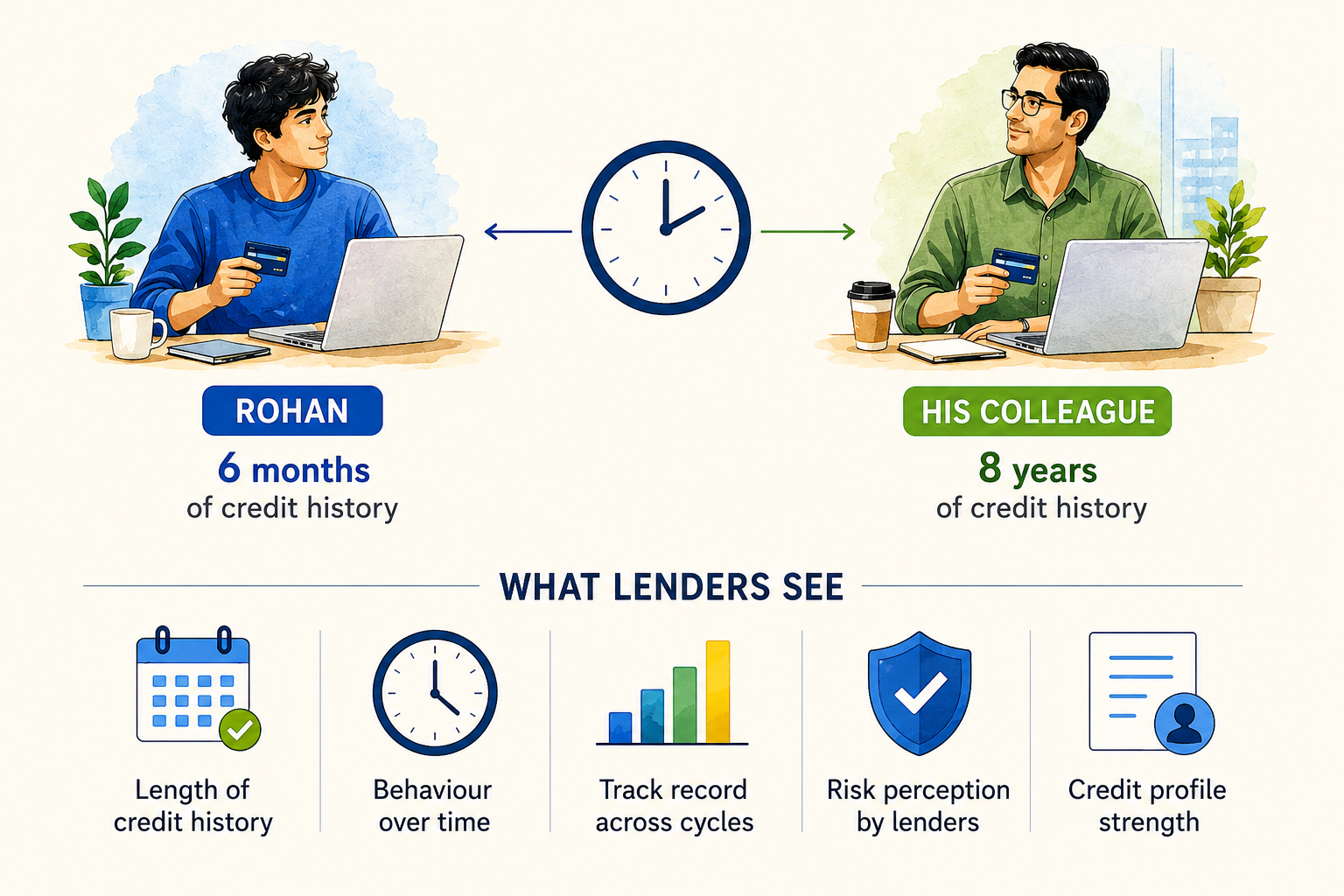
On paper, both look responsible. But one profile gives lenders far more history to assess. That is why the length of your credit history matters. A longer, well-managed record gives more evidence of how consistently you have handled credit over time.
A short history is not necessarily a bad one. It simply means there is less information available yet, and unlike utilisation, this is something only time can build.
How Do Credit Mix and Recent Enquiries Affect Your CIBIL Score?
Neha has been managing a home loan and a credit card for several years. One is secured credit, backed by an asset, while the other is unsecured credit.
This combination is what lenders refer to as your credit mix. TransUnion CIBIL considers the types of credit in your profile, although it does not disclose the exact weight given to this factor. But that does not mean you should take a new loan simply to create a “better” mix. Every additional credit product comes with a real financial obligation.
Now consider another situation.
You are looking for a new credit card and apply to four banks in the same week to see which one approves you. Each time a lender accesses your credit report to assess an application, it may result in a hard enquiry. Several such enquiries within a short period can signal that you are actively seeking more credit. So compare your options first, and apply only when you are reasonably sure the product is right for you.
What Should You Check in Your CIBIL Report?
Suppose your score is lower than expected. Instead of guessing why, you download your CIBIL report and start looking through it.
Four areas deserve your attention first:
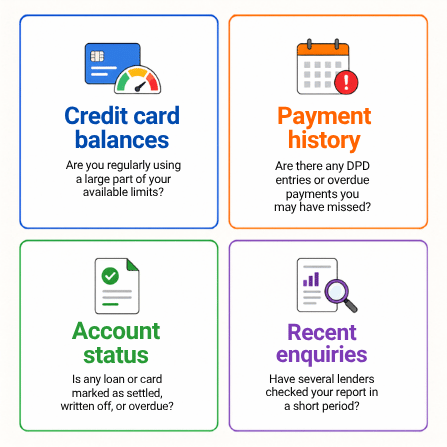
Also check whether the information itself is correct. An unfamiliar account, incorrect payment status, or wrongly reported balance can affect what lenders see.
If you find an error, you can raise a dispute through TransUnion CIBIL’s official dispute-resolution process.
The key is to diagnose the report before trying to “fix” the score. A lower score can have very different causes, and the right action depends on what your report actually shows.
What Can You Do If Your CIBIL Score Is Lower Than Expected?
If your repayments are already on track, the next step is to focus on the parts of your credit profile that actually need attention.
- Reduce high credit utilisation: If your cards are regularly close to their limits, bringing the outstanding balance down can help improve the overall profile.
- Limit unnecessary credit applications: Multiple recent enquiries can signal frequent credit-seeking, so avoid applying for new loans or cards unless needed.
- Allow credit history to build: A short credit history cannot be fixed instantly. Responsible use over time is what gradually adds depth to the profile.
- Avoid borrowing just to improve credit mix: Taking a loan only to diversify your profile creates a real financial obligation for a benefit that is not guaranteed.
- Correct inaccurate information: Check balances, payment status, enquiries and unfamiliar accounts, and raise a dispute with TransUnion CIBIL if anything is reported incorrectly.
Avoid closing an older credit account solely in the hope of improving your score. Its age, available limit, fees and usefulness should all be considered before making that decision.
Conclusion
There is no fixed timeline for improvement. Your credit report first needs to reflect updated information, and any movement in the score will depend on the rest of your credit profile.
If you want to understand what is actually being reported about you, review your CIBIL score and credit report directly through TransUnion CIBIL.
Behind every article is the SSEI Team, bringing together educators, finance professionals, and content specialists to make finance easier to understand.
View All Articles